
Photos
The images show the characteristic double figurados of Cuaba, historic manufacturers such as Romeo y Julieta and La Corona, and details of cigar production. They reflect the development from an almost forgotten shape to a specialised brand since 1996.

History
Cuaba was introduced in 1996 and is exclusively for double figurados. The brand revives a historic cigar shape that had hardly been produced since the 1970s, bringing this sophisticated craftsmanship together under its own brand.
👉 Now read 👉 Cuaba history unique: two-topped cigars

The Cuaba brand, officially introduced in 1996.

The Vista of the Cuaba brand, the brand of double figurados.

The origin of the word Cuaba is explained here: „Cuaba, Cuaba! The native inhabitants constantly repeated whenever the sacred ritual of the cohoba – a smoke aimed to drive away the devil – started.”

A double figurado is a cigar with both ends tapering to a point.
For the brand's 20th anniversary, Cuaba released a special cigar, which, in terms of format, was a Joffres Grande with a 56 ring gauge and a length of 170mm.

There are only 450 of these humidors worldwide for the 20th anniversary of the Cuaba brand.

50 cigars are housed in this 2016 Cuaba Humidor Anniversary.

On the lid of the box, you'll find the Cuaba brand logo. On the inside lid is the explanation of the name's origin.
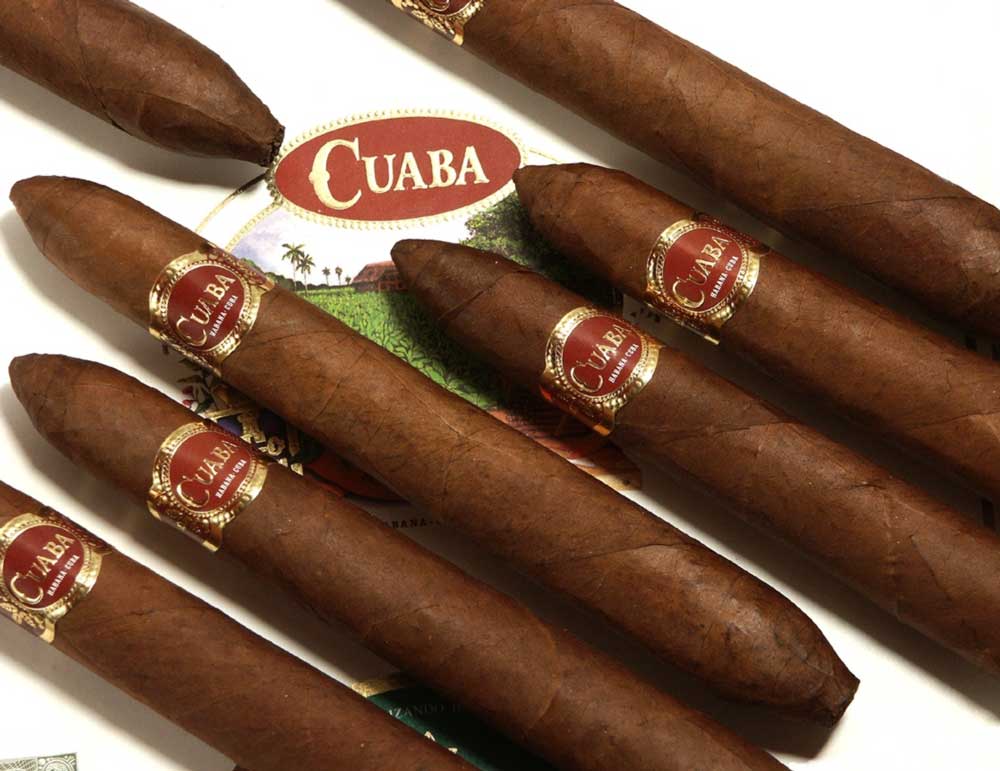
The Cuaba brand stands for double figurados. All cigars in the portfolio are double figurados. The only exception is a Limited Edition from 2008.

A Double Figurado is difficult to craft, with the cigar tapering to a point at both ends. Although the diameter reduces drastically, the cigar still needs to draw.

Introduced in 1996, Cuaba's flagship store, Casa Matriz, was located at Calle Belascoain No. 852 in Havana's Centro Habana district.

During this time, the building at 852 Belascoain housed the Romeo y Julieta factory. Today, it is the H. Upmann factory.

Today (as of 2026), the Casa Matriz, the parent house, of the Cuaba brand is the La Corona factory in Havana on Avenida 20 de Mayo.

Alongside the Cuaba brand, the La Corona factory also produces cigars from the Por Larrañaga, Romeo y Julieta, San Cristobal de la Habana, and Hoyo de Monterrey brands, as can be seen here in the factory's conference room.

On the left, a Parejo, a cigar with the same diameter along its entire length. On the right, a Figurado, a cigar that tapers at one end.

You can clearly see how much the length of cigars in a box used to vary from this Partagás box, which is in its original fill from 1902. (Source: Amir Saarony and contributors: “Partagás – The Book”, ISBN: 978 0 9879290 1 3)
External website: Search Google for Cuaba History
 Deutsch
  Español
  English (UK)
  Français
  Italiano