
Cuaba's Unique History: Double-Tipped Cigars


The Cuaba History It is distinguished by a striking feature that immediately catches the eye: the cigars have two tips. The Cuaba brand is known and unique for its double figurados. While other brands offer single figurados, Cuaba consistently stands for this type of cigar. The brand was officially introduced in 1996.
Where do cigars come from?
Table of contents

For the brand's 20th anniversary, Cuaba released a special cigar, which, in terms of format, was a Joffres Grande with a 56 ring gauge and a length of 170mm.
Form theory: Parejos, Figurados and Torpedos
Fundamentally, a distinction is made between two cigar shapes: Parejos and Figurados. Parejos are the same width at both ends, meaning they have the same diameter over the entire length of the cigar – they make up the vast majority of all cigars. Figurados, on the other hand, taper to a point at one end or both ends (double figurado).
For these shapes, there are several terms: a Double Figurado was often previously called a Perfecto, and a Figurado was called a Pyramid.
The term „torpedo“ was historically used for both variants. However, after the revolution from 1960 onwards, 'torpedo' was mostly used for pyramids – an inaccurate usage.
Originally, the term torpedo denotes an underwater weapon whose body tapers to a point on both sides.

On the left, a Parejo, a cigar with the same diameter along its entire length. On the right, a Figurado, a cigar that tapers at one end.
The origin of the name Cuaba
The word Cuaba originates from the Taíno Indian language and existed long before Columbus discovered the island. According to the reports of the Spanish Jesuit Bartolomé Cobo, the Taíno used the word during a smoke ceremony. They continuously murmured «cuaba, cuaba» to themselves.
During this ceremony, branches of Amyris balsamifera, also known as West Indian sandalwood, were burned. It is a very aromatic and extremely flammable wood. This tree belongs to the citrus family and is not, as one might think, a sandalwood.
With these branches, the Taino then lit their rolled tobacco leaves – the Cohiba. However, whether Cuaba is the designation for this «firebrand» or a designation for the ceremony or an invocation, for example, cannot be clearly answered.

The origin of the word Cuaba is explained here: „Cuaba, Cuaba! The native inhabitants constantly repeated whenever the sacred ritual of the cohoba – a smoke aimed to drive away the devil – started.”
An almost forgotten form
The double figurado was very popular at the end of the 19th and beginning of the 20th centuries, particularly in the so-called Roaring Twenties. After that, this shape became increasingly rare. Hardly any cigars of this type have been produced since the 1970s. Reasons for this include the demanding manufacturing process. The production of double figurados is considered the pinnacle of cigar artistry and is only perfectly mastered by a few torcedores.

A double figurado is a cigar with both ends tapering to a point.
The Rebirth: Introduction 1996
A turning point for the double figurado came in 1996. The Cuaba History It started on 19 November 1996. The brand was launched at London's Claridge's hotel by the then president of Habanos S.A., Francisco Linares. Mastertorcedor Carlos Izquierda Gonzalez travelled to the presentation, heading a 14-strong team to demonstrate the manufacturing of these cigars live.
Cuaba was the first new brand introduced after Cohiba (1982). Initially available exclusively in the UK, it was later exported worldwide.

Introduced in 1996, Cuaba's flagship store, Casa Matriz, was located at Calle Belascoain No. 852 in Havana's Centro Habana district.
Production and Manufactures
From 1996, Cuaba cigars were made at the Romeo y Julieta factory. Today, the La Corona factory on Avenida 20 de Mayo is the headquarters of the Cuaba brand.

Today (as of 2026), the Casa Matriz, the parent house, of the Cuaba brand is the La Corona factory in Havana on Avenida 20 de Mayo.
Fun fact for collectors
In the first six months after their introduction, the cigars were produced without a mould. This had to be developed and manufactured first. The result: the cigars in a box were not exactly the same size. These early boxes are particularly valuable among collectors. The differences were one to two millimetres – a detail that is typical in a historical context. Because, unlike today, at the beginning of cigar production, there were no such fixed and exact formats as there are now.

You can clearly see how much the length of cigars in a box used to vary from this Partagás box, which is in its original fill from 1902. (Source: Amir Saarony and contributors: “Partagás – The Book”, ISBN: 978 0 9879290 1 3)
Formats and developments
The brand's initial Cuaba formats had smaller ring gauges of 42 and 43. Larger ring gauges were introduced later. Cuaba is frequently used for special editions, where new formats are introduced. Humidors in the shape of books are particularly popular for «La Casa del Habano».
The sole exception to the brand DNA: in 2008, the Cuaba Pirámides, an Edición Limitada, was released as a figurado, a cigar with only one tip.
Conclusion
Our Cuaba History shows a brand that is unreservedly committed to one shape. Double figuarados are not only rare but also technically demanding. It is precisely this combination that makes Cuaba unique within the Habanos world.
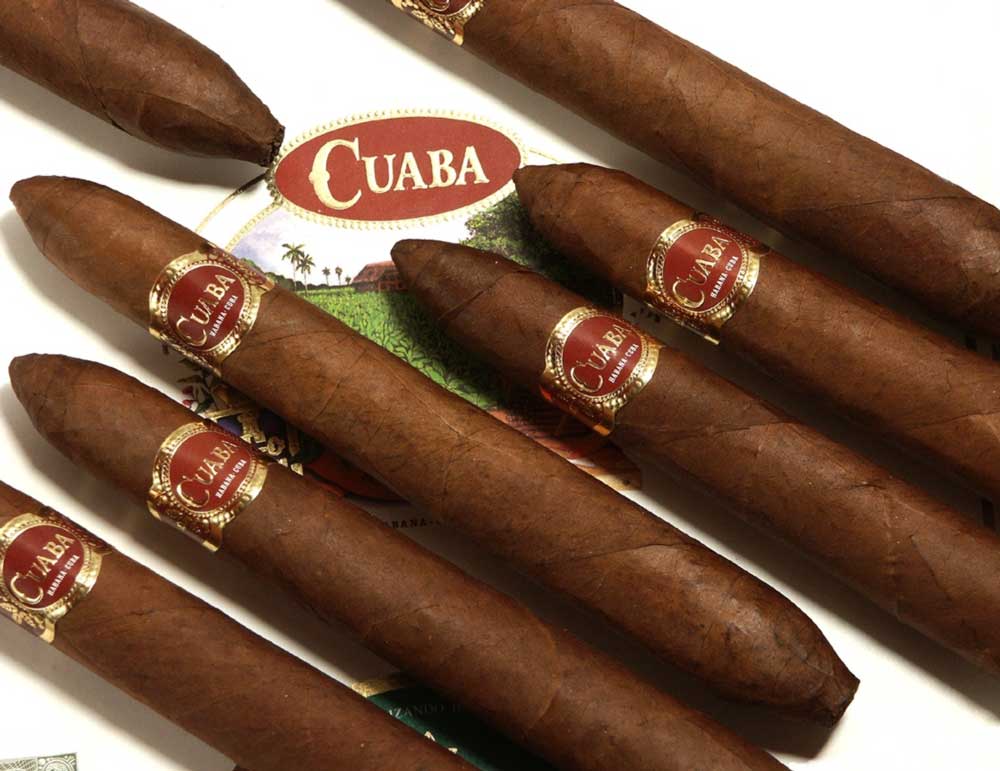
The Cuaba brand stands for double figurados. All cigars in the portfolio are double figurados. The only exception is a Limited Edition from 2008.
Sources
- Min Ron Nee: AN ILLUSTRATED ENCYCLOPAEDIA OF POST-REVOLUTION HAVANA CIGARS
- Cuban Tobacco Research Institute: The World of Habanos
- Alexander Groom: The Modern Habano
- Amir Saarony and Contributors: “Partagás – The Book”, ISBN: 978 0 9879290 1 3
Here you will find the Cuaba factory
If the live folder does not work, Please click here for the Cuaba factory.
Picture credits
- Claudia Puszkar
- Habanos S.A.
Curated for you
External website: Experience the Habanos Club in Germany
At Origin Of Cigar: THE PLEASURE LETTER by Origin Of Cigar: A curated email celebrating the fine pleasures of Cuban cigar culture.
Historical Habanos manufactories documentary film
In this film, their stories - and their true faces - are uncompromisingly revealed. This is far more than just a documentary film - it is a journey into the soul of Cuba.

What is in your drawers?
Some chapters in the history of cigars still lie in hidden in drawers, archives or private collections. Do you own Records, documents or references to Cuban cigar brands? Or do you know Sources, that could help with historical research? Then please send us an e-mail. Claudia Puszkar will contact you personally and discuss everything else with you. Together we can Bringing buried stories back to light. 👉 admin@origin-of-cigar.com
New to Cuban cigars? Or deep into it?
FAQ - Read the frequently asked questions
Open the glossary of Cuban cigars
Who is behind Origin Of Cigar?
Who we are and how you can reach us → Please click here
Cuaba Photo Gallery
If you do not see the photo gallery, Click here for the Cuaba Photo Gallery


References
- Min Ron Nee:
- “AN ILLUSTRATED ENCYCLOPAEDIA OF POST-REVOLUTION HAVANA CIGARS” / Hong Kong 2003, ISBN: 978-3980930826
- Instituto de Investigaciones del Tabaco Cuba:
- „The world of Habanos“ / Havana 2013, ISBN: 978-959-7212-08-9
- Adriano Martínez Rius:
- “Habano the King” / Barcelona 1998, ISBN: 84-930387-1-7
- Adriano Martinez Rius:
- “The Great Habano Factories” / Barcelona 2005, ISBN: 84-609-4024-1
- Orlando Quiroga:
- “El Habano al rojo vivo” / Havana 2002
- Enzo A. Infante:
- “Havana Cigars 1817-1960” / Neptune City 1997
- Eumelio Espino:
- “El Habano - De la semilla al puro en 539 pasos” / Madrid 2019, ISBN: 978-84-09-07091-6
- Alexander Groom:
- “El Habano Moderno” / Helios House Press 2022, ISBN: 978-911683-05-6
You are here:

 Deutsch
  Español
  English (UK)
  Français
  Italiano