
Maturing Cuban cigars - The silent art of patience


Curing Cuban cigars requires knowledge and experience. When you light a fresh Habano, you experience the untamed power of tobacco. Young, wild, sometimes even spicy. A fresh Habana can taste wonderful - but just a few months after rolling, the cigar is often unrecognisable. This is just the beginning of a long journey. The ageing of Cuban cigars is no coincidence, but a process that needs to be understood. We are talking about box storage here, not individual cigars.
The options presented here are aimed at the normal cigar lover - in other words, those who want to store their Habanos consciously, but without excessive technical or scientific means. Collectors and experts often go much further: they use specialised climate chambers, different storage systems and other complex systems to ensure that each individual box matures perfectly.
Where do cigars come from?

Table of contents
The topic of tyre storage is sometimes the subject of controversial debate.
Discussion about the draw resistance
Hardly any other topic is as controversial among aficionados as the Draw resistance of Cuban cigars. Time and again you hear the claim that Habanos often have far too strong a draw. Critics like to talk about rolling faults. Personally, I cannot confirm this assessment - perhaps also because I buy my cigars in Switzerland and the quality for this market is possibly selected with particular care. I cannot prove this, it remains an assumption.
There are two reasons why this can happen. Reason 1 is the so-called Sick period. This is a phase a few months after production in which the cigar is in a kind of intermediate stage in terms of flavour. During this time, many cigars have a dull, unbalanced or even unpleasant flavour. At the same time, there is often the impression of an excessively firm draw resistance - a condition that disappears as the cigar matures.
A second common reason for excessive tension is incorrect storage. If cigars are stored too damp, the tobacco leaves swell and constrict the air channels. Cuban cigars feel good at a relative humidity of 65-69 % most comfortable. These conditions cannot always be realistically realised in the humidor at home.
If a cigar actually has too tight a draw, there is a simple trick: leave it outside the humidor for an hour or two - but not in the sun. During this time, it releases excess moisture and the draw resistance usually improves significantly.
Why mature cigars?
Cuba has very limited tobacco resources. Unlike manufacturers in Nicaragua or the Dominican Republic, Cuba cannot afford to let the tobacco leaves rest and mature for years. Instead, the tobacco is processed relatively fresh and the cigars go on sale early. But that is precisely part of the fascination: the tobacco lives on, it works, it develops - this maturing process continues in the aficionado's humidor.
Tobacco is a living natural product. After rolling, the leaves still contain ammonia and other volatile substances that can impair the flavour experience. During storage, these substances break down and the flavours begin to combine. Corners and edges become harmony, loud tones become an orchestral interplay. A cigar that may seem intrusive when young often reveals its true elegance after a few years of storage.
But ageing is not a rigid process. Every brand, every vitola reacts differently. A strong Partagás or Bolivar can develop an almost majestic depth after ten years, while a milder H. Upmann may reach its perfect balance after just two to three years.
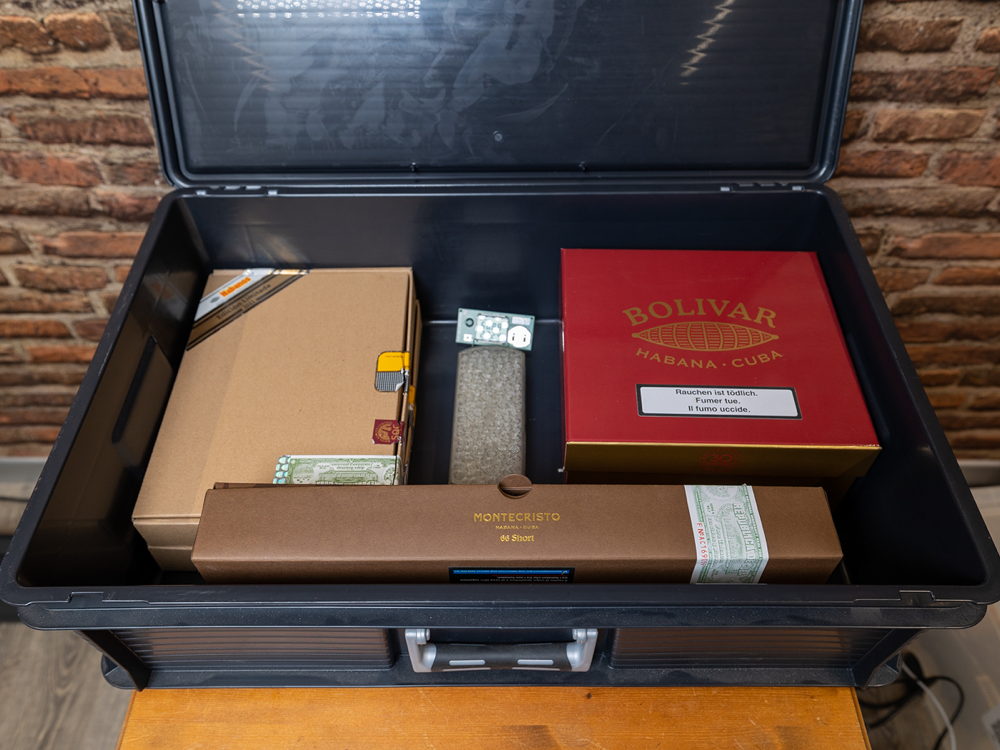
It also works in plastic boxes. Instead of the humidifier shown here, you can also place several Boveda in the box.
But what about Gran Reserva, Reserva or Limitadas?
It is often claimed that cigars from the series Gran Reserva, Reserva or Edición Limitada are perfectly smokable as soon as they are released. After all, their tobacco is made from specially selected leaves that have been allowed to mature for several years before rolling. At first glance, this sounds logical: if the tobacco has already been stored for years, why should the finished cigar need any more time?
My experience is completely different. I tasted Gran Reservas and Reservas immediately after their market launch - and many of them tasted harsh, inharmonious, even bitter. A few years later, it was a completely different experience: balanced, harmonious and with a depth that I hadn't realised before.
The same applies to the Edición Limitada. Here, too, I observe the same effect: some cigars seem amazingly complex and balanced in their early phase. But after a few weeks, these qualities suddenly disappear and the cigar falls into the familiar Sick period. Only after years does she return to her balance.
The reason lies in the manufacturing process: Each tobacco is moistened before rolling. This produces ammonia, which can disrupt the flavour in the early stages. Depending on the tobacco composition, this leads to cigars that appear unruly, edgy or unbalanced - even if the tobacco has been matured for years. Even the finest leaves are not exempt from this. Only when this phase has been overcome do the true strengths of these special series unfold.
The magic of the conditions and the heated debate
For this silent transformation to succeed, the right framework conditions are needed. And these are no secret - rather a question of consistency. And here there are two Habanos cigar lovers Fractions, who sometimes fiercely debate which storage method is the best.
- Temperature
- Fraction 1: 18-21 °C → Tobacco unfolds its full potential.
- Fraction 2: 14-17 °C → slower maturation, more balanced.
- Air humidity
- Fraction 1: 70-72 % → ideal, as long as not too dry (loss of oil and flavour) or too moist (risk of mould).
- Fraction 2: 65-69 % maximum → is considered a safe range, also depending on the temperature.
- Air circulation
- Fraction 1: Cigars need „room to breathe“, do not fill the humidor too full. Open the humidor from time to time and let fresh air in.
- Fraction 2: Keep the humidor closed, only open it to change the humidification (e.g. Boveda). Store as compactly as possible.
Both groups say the most important thing: Stability. Fluctuations are the biggest enemy of cigar storage. A good humidor is therefore not just storage, but a protective cocoon.
I know some collectors who wrap their boxes in household foil, insert a 69% Boveda and then store them. Others rely on aluminium or plastic crates, while still others swear by classic wooden humidors. There is often a passionate debate about which method is the right one. My opinion: everyone should choose the method that suits their possibilities - because not everyone has a cellar with perfect and constant climatic conditions.
Time as a decisive factor
Patience is probably the most important ingredient. After just 12 months of storage, a smoother, more balanced cigar emerges. depending on brand and vitola. After two years, it seems rounder, the sharpness has disappeared, the flavours have merged. But the real adventure often begins beyond this threshold:
- 3 to 5 years: Many Cuban cigars gain in balance and allow their DNA to be recognised more clearly.
- 5 to 10 years: Strong formats such as Double Coronas or thick Robustos often reach their peak. Earthy, spicy notes transform into more complex depth.
- 10+ years: Only the best specimens survive this ripening period with flying colours. This results in flavours of incredible finesse.
However, not every cigar gets better with age. Some lose strength and character after being stored for too long. That is why it is sometimes an art to recognise the right time.
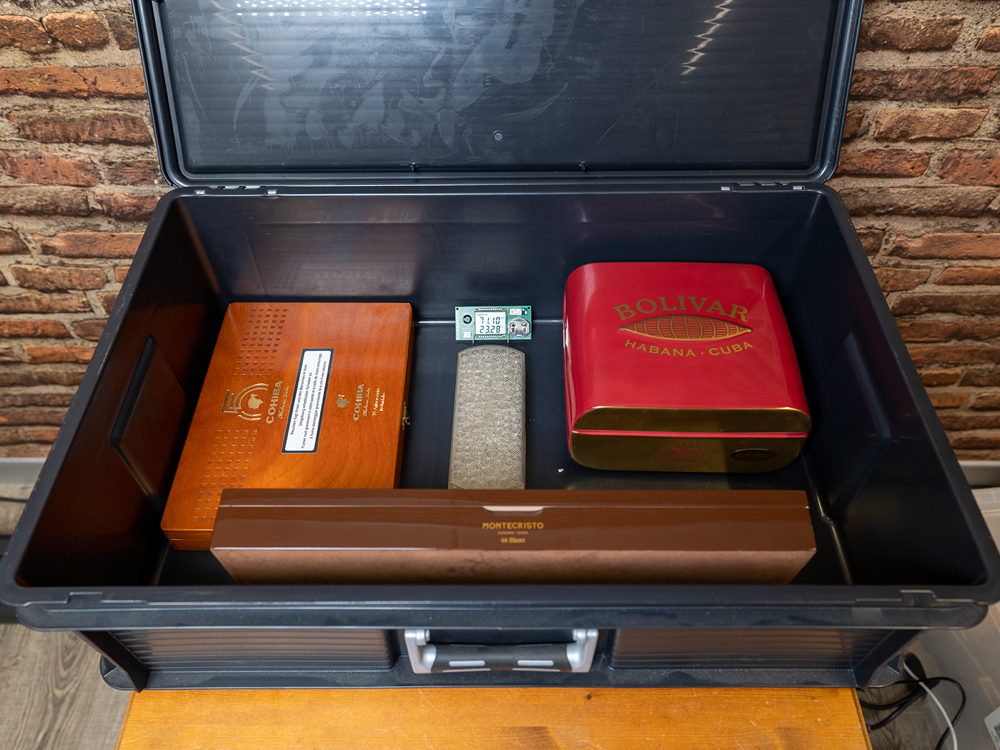
It also works in plastic boxes. Instead of the humidifier shown here, you can also place several Boveda in the box.
Myths, legends and reality
There are countless myths surrounding the ageing process. Some aficionados swear that every Cuban cigar must be stored for at least 20 years. Others claim that only fresh cigars have the true „Cuban punch“.
The reality lies in between. Not every cigar is a „long-distance runner“, nor does it lose its appeal after a short time. The truth is that every box, every format and often even every individual cigar has its own development curve. And that is precisely where the magic lies.
There are also legends about secret storage rooms in Havana where cigars rest for decades before being offered to selected retailers. Such stories add to the fascination - and even if they are not always true, they still reflect the magic that the thought of perfectly matured Habanos triggers.
The emotional value of tyre storage
Those who allow cigars to mature are not just practising patience. They celebrate anticipation. Every opened box becomes a journey into the past - back to the moment you bought it, with the decision: „I'm saving this one.“
It is a quiet, almost meditative process: opening the humidor, inhaling the aroma of maturing tobacco, carefully examining the boxes. And at some point, the day comes when you light one of the cigars - and know for sure that it was worth the wait.
Conclusion - ageing Cuban cigars
The Maturing Cuban cigars is not a duty, but a gift. It requires time, dedication and a little knowledge of the conditions. But those who give it this attention will be rewarded with flavours that are deeper, more harmonious and more fascinating than they could ever be fresh.
It is the silent art of patience - and perhaps the most beautiful secret that the world of Habanos has to offer.
Picture credits
Curated for you
At Origin Of Cigar: More You can read tips in the reviews
External website: Cigars.zone, theme week storing cigars
References
- German edition 2005, Min Ron Nee: An illustrated encyclopaedia of post-revolutionary Havana cigars, Hong Kong
- Hunters & Frankau
- Conversations with collectors who told me about their experiences and showed me their storage facilities
What is in your drawers?
Some chapters in the history of cigars still lie in hidden in drawers, archives or private collections. Do you own Records, documents or references to Cuban cigar brands? Or do you know Sources, that could help with historical research? Then please send us an e-mail. Claudia Puszkar will contact you personally and discuss everything else with you. Together we can Bringing buried stories back to light. 👉 admin@origin-of-cigar.com
New to Cuban cigars? Or deep into it?
FAQ - Read the frequently asked questions
Open the glossary of Cuban cigars
Who is behind Origin Of Cigar?
Who we are and how you can reach us → Please click here
You are here:



 Deutsch
  Español
  English (UK)
  Français
  Italiano