
Cuba History Part 3: Chinchales and palaces - Cuba - Iconic: Boom, forgeries and the introduction of lithography


Chinchales. This is part 3 of the series History Cuba, which describes the rapid rise of the chinchales, the introduction of lithography and the emergence of Havana's cigar palaces.
After the abolition of the monopoly in 1817, Havana experienced an unprecedented boom. Businessmen from New York, Philadelphia, London, Paris, Hamburg and other cities flocked to do business with the Habano. The cigar became a status symbol worldwide, exuding an air of luxury; the largest quantities went to Spain, but the USA also bought a lot. In 1840 there were 306 factories, by 1861 there were already 516 - a rapid expansion of the chinchales into a veritable industry.
Series „History Cuba“ - A 6-part documentary journey through the history of Habanos. 👉To the complete overview of the series.
Where do cigars come from?
Table of contents part 3
Counterfeits enforce visible origin
With international demand, there were more and more counterfeits. A solution was needed that made authenticity visible. In 1845, the Spaniard Ramón Allones, who lived in Havana, was the first to pack his Habanos in boxes of 25 and label the lids with an illustration explaining the product and origin - printed using lithography. This turned packaging into a medium for labelling origin.
Lithography & chromolithography: technology with a signalling effect
Lithography (invented in 1798) is a lithographic printing process for reproducing text and images. There was already a workshop in Havana in 1822, and the number quickly grew. Coloured chromolithographs soon replaced the simple prints: elaborate, often gilded depictions that are still considered works of art today. The message was clear: a valuable presentation emphasises the high quality of the product - and protects buyers from deception.
Brand building through visual language
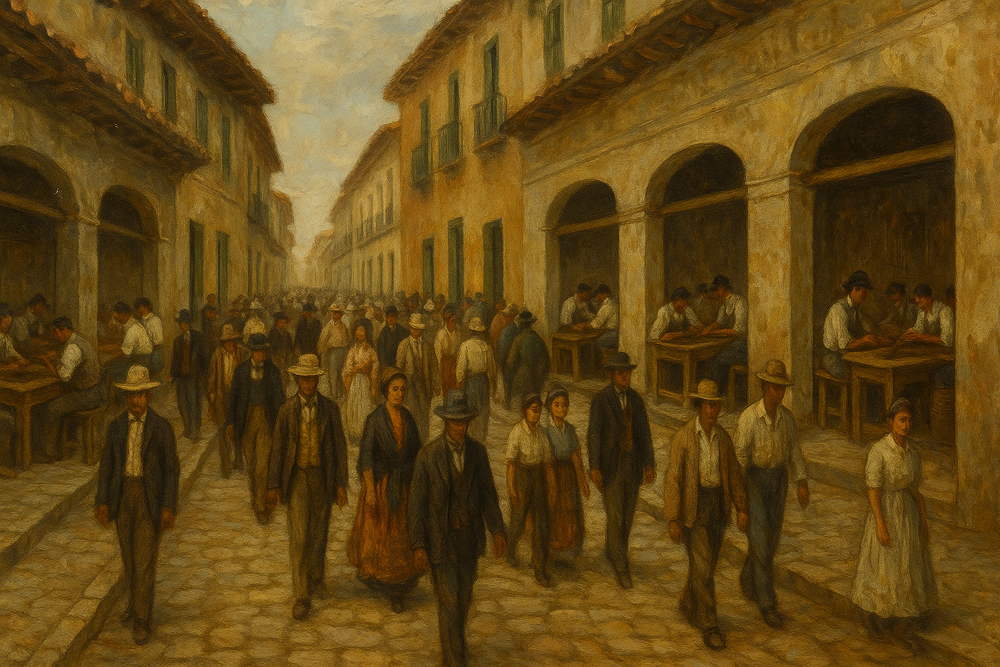
The new box lids told stories: Cityscapes, coats of arms, allegorical figures. They made brands recognisable and created trust - in a market where names from the Chinchales era circulated frequently and it was not always clear who they belonged to. In this way, craftsmanship, trade and design merged to form a forerunner of modern brand management.
From the workshop network to industry
The figures reflect the dynamic: alongside the chinchales, more and more larger manufacturers emerged. The boom in chinchales in Cuba changed labour requirements, supply chains and export logistics - and set the stage for the prestigious manufactory buildings that were to characterise Havana in the following decades.
Cigar palaces
Cigar palaces in Havana: By the middle of the 19th century, the Habano had become a global status symbol; in 1855, over 356 million cigars were exported.
Between 1840 and 1860, the construction of buildings specifically built as cigar factories began - a novelty. The first: El Fígaro and the Punch factory (1840), the Partagás factory (1845), La Reforma and La Africana; La Majagua also exists as a building to this day, although no longer as a factory.
Density, size, employment
The boom continued: in 1861 there were 516 factories in Havana and the surrounding area with 15,128 employees; 158 houses were considered „first class“ (> 50 scooters each), the largest factories employed well over 500 workers.
1863: Space for palaces
A royal decree had parts of the city wall torn down in 1863; areas close to the city centre were created. Around 1880, palatial buildings were erected there - an expression of competition and prosperity. These included La Escepción (José Gener), La Meridiana by Pedro Murias, Calixto López, the Palacio Villalba (for José Suárez Murias’ brand) and the Palacio Aldama (including the La Corona production site).
The „Habano Golden Perimeter“
The convenient location was important: the tobacco arrived in the capital by train; the railway station was located where the Capitol stands today. Factories were located in close proximity to each other - a cluster that became known as the Habano Golden Perimeter. In addition to logistics, the palaces also offered optimal working conditions for torcedores - a production environment that combined efficiency, quality and prestige.
Outlook
Chinchales as flexible germ cells, lithography as protection and signalling: this is how origin became visible and the Habano became distinguishable worldwide. The Havana cigar palaces are built industrial history: they visualise the economic rise of the Habano. Next part: Troubled years until the Republic of 1902.
Continue in the series „History Cuba“
This was part 3 of the series „History Cuba“. → Back to Part 2: Spanish colonial rule → Continue to Part 4: Troubled times and guarantee seals → To the complete overview
Picture credits
- Cover elements: ChatGPT
- Image in text: ChatGPT
Curated for you
External website: Habanos Club Germany
At Origin Of Cigar: Fancy even more history about Cuba cigars?
Historical Habanos manufactories documentary film
In this film, their stories - and their true faces - are uncompromisingly revealed. This is far more than just a documentary film - it is a journey into the soul of Cuba.

What is in your drawers?
Some chapters in the history of cigars still lie in hidden in drawers, archives or private collections. Do you own Records, documents or references to Cuban cigar brands? Or do you know Sources, that could help with historical research? Then please send us an e-mail. Claudia Puszkar will contact you personally and discuss everything else with you. Together we can Bringing buried stories back to light. 👉 admin@origin-of-cigar.com
New to Cuban cigars? Or deep into it?
FAQ - Read the frequently asked questions
Open the glossary of Cuban cigars
Who is behind Origin Of Cigar?
Who we are and how you can reach us → Please click here
General references
- Min Ron Nee:
- “AN ILLUSTRATED ENCYCLOPAEDIA OF POST-REVOLUTION HAVANA CIGARS” / Hong Kong 2003, ISBN: 978-3980930826
- Instituto de Investigaciones del Tabaco Cuba:
- „The world of Habanos“ / Havana 2013, ISBN: 978-959-7212-08-9
- Adriano Martínez Rius:
- “Habano the King” / Barcelona 1998, ISBN: 84-930387-1-7
- Adriano Martinez Rius:
- “The Great Habano Factories” / Barcelona 2005, ISBN: 84-609-4024-1
- Orlando Quiroga:
- “El Habano al rojo vivo” / Havana 2002
- Enzo A. Infante:
- “Havana Cigars 1817-1960” / Neptune City 1997
- Eumelio Espino:
- “El Habano - De la semilla al puro en 539 pasos” / Madrid 2019, ISBN: 978-84-09-07091-6
- Alexander Groom:
- “El Habano Moderno” / Helios House Press 2022, ISBN: 978-911683-05-6
You are here:


 Deutsch
  Español
  English (UK)
  Français
  Italiano