
History Cuba Part 1 - Columbus and Cuba: First landing, ancient cultures - and the path of tobacco

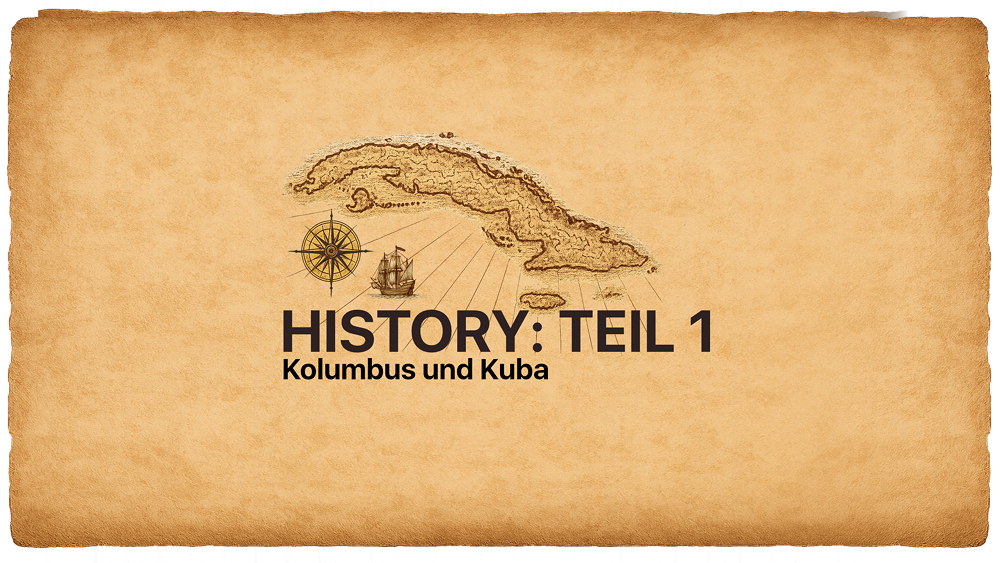
Columbus and Cuba. This is part 1 of the series History Cuba, which documents the development of Cuban tobacco culture from 1492 to the present day.
28 October 1492: Christopher Columbus reaches the north-east coast of an island he believes to be an outpost of Asia. The scene has been told many times, but it remains fascinating - because of the moment of the first encounter and because of what had been there long before: independent cultures and a knowledge of plants that would change the world.
Series „History Cuba“ - A 6-part documentary journey through the history of Habanos. 👉To the complete overview of the series.
Where do cigars come from?
Table of contents part 1
Columbus reaches Cuba (1492)
The chronology is well documented: On his first voyage, Columbus landed on the north-east coast of Cuba on 28 October 1492. He initially interpreted the coast as the edge of the Asian mainland („Cathay“). His errors were quickly corrected, but the basic fact remains: The admiral mapped sections of the Cuban coast and reported friendly encounters with the inhabitants. For terms and names, please see the fact check below.
Where exactly did Columbus set foot on land?
Research places the landing site in what is now the province of Holguín. The Bay of Bariay is often cited as the site of the first landing. The exact location is disputed; the arrival on the north-eastern coast of Cuba at the end of October 1492 is certain.
Before Columbus: Taíno, Ciboney and Guanahatabey
Before 1492, Cuba was inhabited by various indigenous groups. It is assumed that the island of Cuba has been inhabited for around 10,000 years.
At the end of the 15th century, the Taíno, Arawak-speaking village communities with complex social structures under hereditary chiefs (caciques), made up the largest proportion. There is also evidence of the Ciboney (often associated with cave dwellers) and the Guanahatabey, a hunter-gatherer population living in western Cuba, who were linguistically and culturally distinct from the Taíno. Archaeology and sources point to several waves of migration to the Caribbean, beginning with early hunter-gatherers and later Arawak migrations from northern South America.
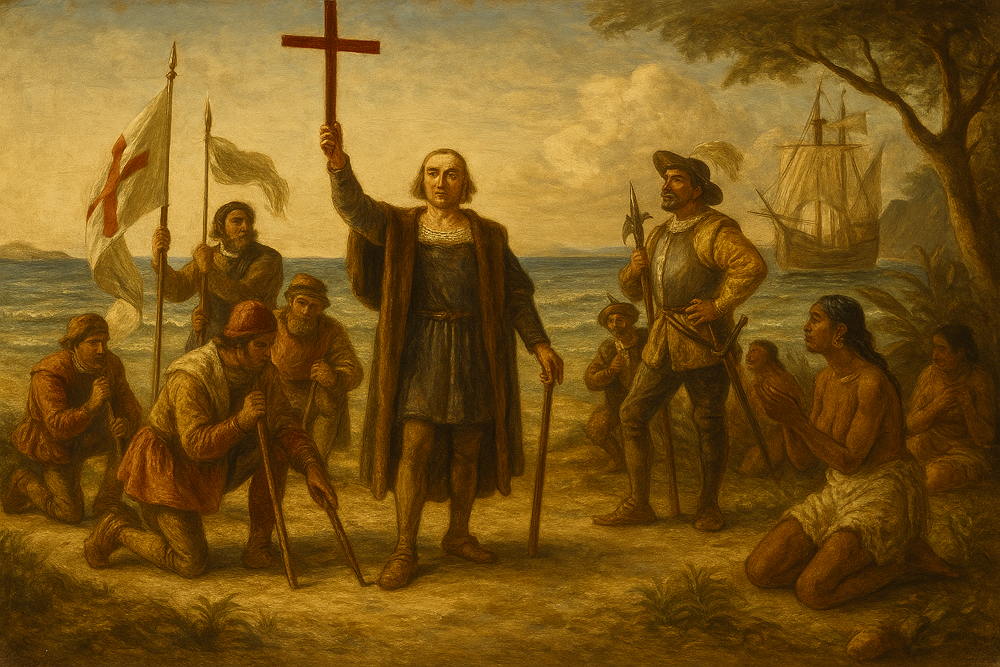
Columbus and Cuba: The Landing interpreted by ChatGPT.
„Dried leaves, rolled up“: The first European observation of smoking
The earliest European description of tobacco smoking comes directly from the area surrounding the landing: Columbus sent Rodrigo de Jerez and Luis de Torres inland on 2 November 1492. The report, handed down in the summary by Bartolomé de las Casas, records that locals formed dried leaves into rolls, lit one end and drew in the smoke.
⚠️ The designation of these roles is not completely standardised in the earliest sources. please read the fact check below.
Fermentation: only standardised later
The early colonial descriptions show that the indigenous practice primarily involved drying and bundling the leaves. Controlled fermentation - i.e. the „sweating“ of large quantities of leaves in piles with temperature control and restacking - is a later refinement of the colonial and modern cigar trade. To this day, specialised dictionaries describe the process chain as a sequence of harvesting, drying, maturing/storage and (in the case of cigar leaves) fermentation. But please note: tobacco cannot be consumed without fermentation.
Cohoba is not tobacco
In addition to the smoking of leaf rolls, a ritual snuff is known from the Greater Antilles: Cohoba. This is a powder made from the seeds of the yopo tree (Anadenanthera peregrina) with the active ingredients DMT and bufotenin, which is inhaled via Y-shaped tubes. Cohoba and tobacco must therefore be strictly distinguished: One is a hallucinogenic ritual preparation, the other a stimulant and medicinal plant that was smoked and snuffed. Please read the fact check below.
How did tobacco get to Cuba?
Botanically, cultivated smoking tobacco (Nicotiana tabacum) is a hybrid of N. sylvestris (maternal line) and N. tomentosiformis (paternal line), which originated in the Andes region of South America. Genome studies confirm this origin. From there, tobacco spread northwards long before 1492 - via trade and migration networks of Arawak-speaking groups to the Greater Antilles. Cultivated plants, knowledge and ritual practices, including smoking, travelled with them to Cuba.
From bundles of smoke to Habanos culture
The indigenous practice of smoking was therefore established in Cuba when Columbus landed. What later became the Habanos culture - elaborate cultivation, sophisticated fermentation and skilful rolling - emerged under colonial conditions and developed over centuries into a cultural technique in its own right. The path from dried leaf bundle to premium cigar shows how deeply prehistory and early history are intertwined.
⚠️ Fact check: „tabacos“, „Cohiba“, „cohoba“ - and why terms are often confused
1) „... llaman ellos tabacos“ (Las Casas): In the tradition of the Columbus Journal by Bartolomé de las Casas, the smoke rolls appear as „tabacos“. En Spanish paraphrase with original quote can be found here(with bibliographical reference to Las Casas). In addition, an English edition of the journal notes the observation of the „dried leaves rolled up“ (footnote)
2) Alternative finding (Oviedo): Gonzalo Fernández de Oviedo describes the term „tabaco“ in connection with a Y-shaped inhalation instrument (snuffing or smoking device). See, among other things, the edition of his „Historia general y natural de las Indias“ at the Internet Archive and the bibliographic reference at BHL. // On the etymology debate, see the JSTOR article (1889)
3) Brand and industry narrative „Cohiba“: The official narrative of Habanos S.A. is that „Cohiba“ is an old Taíno word for the rolled leaves that Columbus’ men saw in 1492 - hence the „first name of tobacco“. Source 1 and Source 2.
4) Important difference word „cohoba“: „Cohoba“ refers to a ritual snuff powder (Yopo/Anadenanthera), which was drawn in through Y-shaped tubes - it is not tobacco. Solid quick reference: Encyclopaedia Britannica.
5) Conclusion on the history of the word: The etymology of „tabaco/tabaco“ is disputed in the specialist literature (role name vs. instrument name, possibly also place reference). The practice of smoking is undoubtedly documented before 1492; the later cigar processes (fermentation etc.) are colonial and modern refinements.
Continue in the series „History Cuba“
This was part 1 of the series „History Cuba“. → Continue to Part 2: Colonial rule and Chinchales → To the complete overview
Picture credits
- Cover elements: ChatGPT
- Image in text: ChatGPT
Curated for you
External website: Habanos Club Germany
At Origin Of Cigar: Fancy even more history about Cuba cigars?
Historical Habanos manufactories documentary film
In this film, their stories - and their true faces - are uncompromisingly revealed. This is far more than just a documentary film - it is a journey into the soul of Cuba.

What is in your drawers?
Some chapters in the history of cigars still lie in hidden in drawers, archives or private collections. Do you own Records, documents or references to Cuban cigar brands? Or do you know Sources, that could help with historical research? Then please send us an e-mail. Claudia Puszkar will contact you personally and discuss everything else with you. Together we can Bringing buried stories back to light. 👉 admin@origin-of-cigar.com
New to Cuban cigars? Or deep into it?
FAQ - Read the frequently asked questions
Open the glossary of Cuban cigars
Who is behind Origin Of Cigar?
Who we are and how you can reach us → Please click here
References for part 1: Columbus
Encyclopaedia Britannica - Christopher Columbus: The first voyage
Encyclopaedia Britannica - Where Did Columbus Land?
Encyclopaedia Britannica - History of Cuba
CubaPlus Magazine - Bariay Monument National Park (Holguín)
Holguín City - Bariay Park (National Monument)
Encyclopaedia Britannica - Taíno
Encyclopaedia Britannica - Ciboney
Encyclopaedia Britannica - Guanahatabey
Encyclopaedia Britannica - West Indies: The Pre-Columbian period
PDF: Columbus, Journal of the First Voyage (Las Casas abstract) - University of Kentucky
PDF: Columbus, Journal of the First Voyage - LatinAmericanStudies.org
PDF: Las Casas, Historia de las Indias - Edición digital (vol. 1, PDF, Argentina.gob.ar)
Las Casas quote paraphrase with references
Fernández de Oviedo, Historia general y natural de las Indias - Internet Archive
Fernández de Oviedo, Historia general y natural de las Indias - KCL e-text
Etymology of the Word Tobacco (A. Ernst, 1889) - JSTOR
Encyclopaedia Britannica - Cohoba
Habanos S.A. - Unique since 1492
Encyclopaedia Britannica - Tobacco (cultivation & processing)
Nature Scientific Data (2024) - Chromosome-level genome assemblies of Nicotiana
N. Sierro et al. (2013) - Reference genomes and transcriptomes of Nicotiana (PMC)
Z. Tong et al. (2024) - Retrospect and prospect of Nicotiana tabacum genome (PMC)
General references
- Min Ron Nee:
- “AN ILLUSTRATED ENCYCLOPAEDIA OF POST-REVOLUTION HAVANA CIGARS” / Hong Kong 2003, ISBN: 978-3980930826
- Instituto de Investigaciones del Tabaco Cuba:
- „The world of Habanos“ / Havana 2013, ISBN: 978-959-7212-08-9
- Adriano Martínez Rius:
- “Habano the King” / Barcelona 1998, ISBN: 84-930387-1-7
- Adriano Martinez Rius:
- “The Great Habano Factories” / Barcelona 2005, ISBN: 84-609-4024-1
- Orlando Quiroga:
- “El Habano al rojo vivo” / Havana 2002
- Enzo A. Infante:
- “Havana Cigars 1817-1960” / Neptune City 1997
- Eumelio Espino:
- “El Habano - De la semilla al puro en 539 pasos” / Madrid 2019, ISBN: 978-84-09-07091-6
- Alexander Groom:
- “El Habano Moderno” / Helios House Press 2022, ISBN: 978-911683-05-6
You are here:



 Deutsch
  Español
  English (UK)
  Français
  Italiano